Written by:
We Haul Texas Team
Published:
September 29, 2026
Learn how to pack wine glasses for moving so they survive the truck ride. Materials, box setup, and the mistakes that crack stems most often.
Wine glasses break in moving boxes for one reason more than any other: the stem takes the weight of everything stacked above it instead of the bowl or base. Pack them stem-protected, upright when possible, and cushioned so nothing touches glass to glass, and you can move a full cabinet of stemware without losing a single piece. The fix isn't more tape or a sturdier box, it's how you cushion the specific weak point on each glass.
Stemware is one of the most commonly broken categories in any move, right alongside dishware and picture frames, but it fails for a different reason. Plates crack under weight distributed across a flat surface. Wine glasses snap at the thinnest point, which is almost always somewhere on the stem, because that's what flexes when a box gets jostled, tilted, or set down harder than it should be. Once you understand that, the packing method gets a lot more obvious.
You need packing paper (not newspaper, which leaves ink residue on glass), cell dividers or a box with built-in stemware slots, and a sturdy box no larger than roughly 1.5 cubic feet. Bubble wrap is optional and mostly useful for extra insurance on crystal or unusually thin glasses.
Skip the instinct to reach for whatever paper is on hand. Newsprint transfers ink onto glass surfaces, and getting that off later is its own annoying job. Clean, unprinted packing paper works better and costs little. If you have access to a dish-pack box with a cell divider insert, that single upgrade solves most of the risk on its own, since it keeps each glass in its own compartment and stops glass from ever touching glass.
A box that's too large invites shifting during the drive, and shifting is what turns a well-wrapped glass into a broken one. Smaller, fully packed boxes that don't have room to move around inside the moving truck protect stemware better than a bigger box with more cushioning material but more empty space.
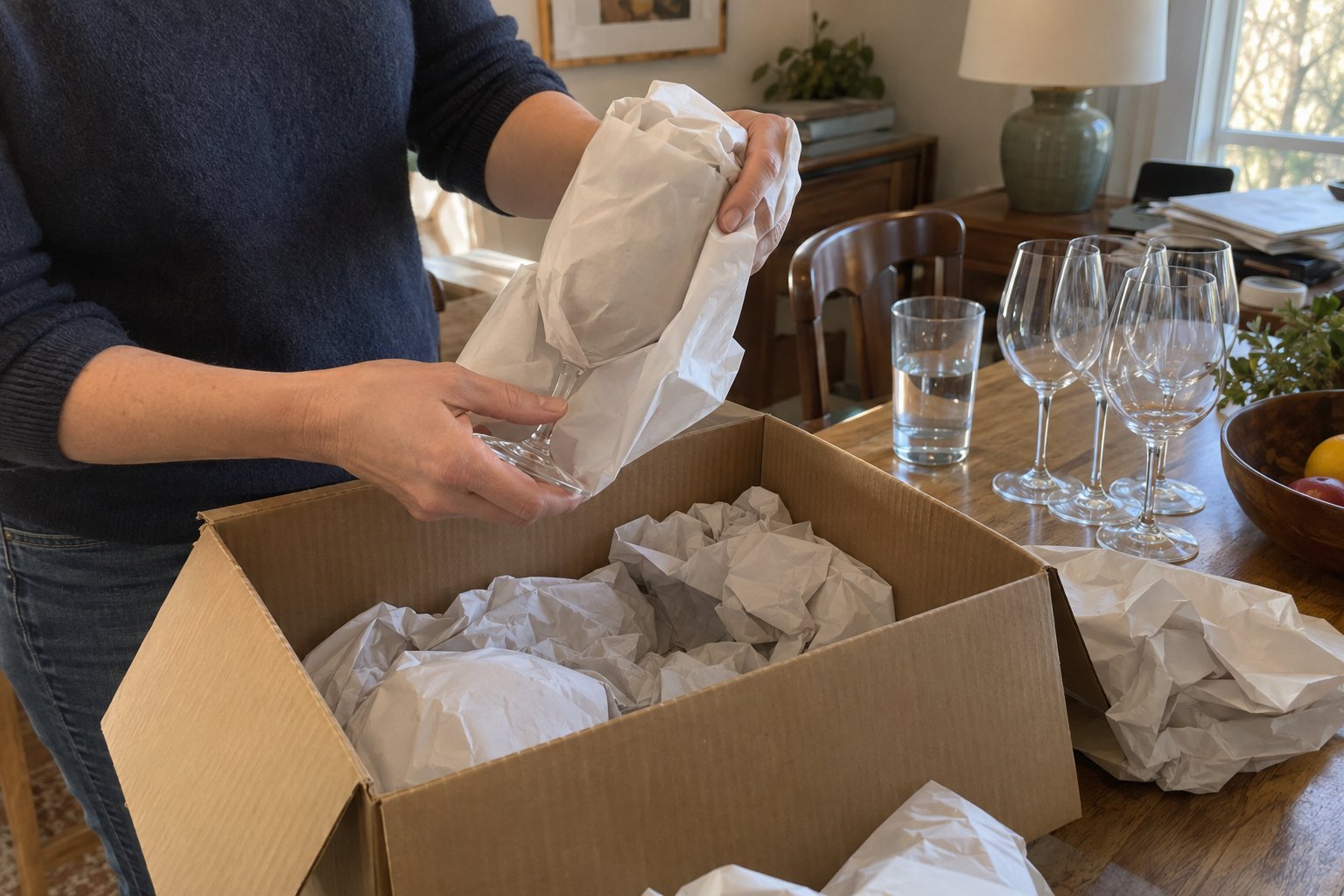
Wrap paper around the bowl first, then bring extra paper down and around the stem and base as a separate, dedicated wrap, almost like giving the stem its own splint. The base needs its own layer too, since a chip on the foot can make an otherwise fine glass wobble or leak.
Lay a sheet of paper flat, place the glass on its side near one corner, and roll it up so the bowl is fully covered before you even get to the stem. Then twist the excess paper at the stem end and fold it under the base, so the stem is wrapped in a thicker bundle than the rest of the glass. That extra bulk at the narrowest point is what keeps it from flexing when other items press against it in the box. For glasses with unusually delicate or hand-blown stems, add a second wrap of paper or a strip of bubble wrap specifically around that section before moving on.
Upright, resting on their base inside a cell divider or with a cushioned bottom layer under them, is generally safer than upside down. Standing a glass on its rim concentrates the weight of the glass on the thinnest, most exposed edge, which is more likely to chip than the base.
If you're using a box without dividers, build a cushioned base layer of crumpled paper at least two inches thick, stand the wrapped glasses upright on that layer, and fill every gap between them with more paper until nothing can lean or slide.
Pack heavier, sturdier glasses toward the bottom corners of the box and place lighter or more delicate stemware toward the center, where it's naturally cushioned on all sides. Fill every remaining gap with crumpled paper until you can shake the box gently and hear no movement.
That shake test matters more than it sounds like it should. If glasses can shift even slightly during loading, they'll shift a lot more over hours on a truck navigating stop-and-go traffic. Top off the box with a final layer of paper before closing it, so there's cushioning between the glasses and the lid, and label the box "fragile, glass, this side up" on at least two sides so it gets handled and loaded accordingly.
A dish-pack box with a cell divider typically holds a dozen to eighteen standard wine glasses safely, depending on cell size. Without a divider, keep the count lower, generally eight to ten per box, so there's enough paper cushioning between each glass to matter.
Treat anything irreplaceable, whether it's crystal, a family heirloom set, or hand-blown glass, as a category of its own and pack it separately from everyday stemware. Add a second layer of wrapping, use a smaller box so there's less weight and less chance of shifting, and consider transporting it in your own vehicle rather than on the moving truck.
This is the same logic that applies to other high-value, hard-to-replace items during a move. If you're also sorting out how to handle jewelry, important documents, or other small valuables, our guide on items movers typically won't take on the truck covers what belongs in a personal bag instead of a box, and the same caution applies to a set of crystal glasses your grandmother gave you.
If you have the time and the right materials, packing your own stemware is completely reasonable and often what people prefer for sentimental or high-value pieces. If you're short on time, packing a full kitchen and bar cabinet on top of everything else in a move, or simply want the insurance that comes with professional packing, it's worth handing off.
A crew that packs fragile items daily works faster and, in most cases, more consistently than a first-time attempt, and many movers offer packing materials and labor as a standalone add-on rather than a full-service requirement. If you'd rather not spend an evening wrapping forty pieces of stemware by hand, our professional packing services can handle the glassware, dishware, and anything else fragile while you focus on the rest of the move.
Good technique gets you most of the way, but a rough ride in the truck or a rushed loading job can undo careful wrapping. Working with a crew that knows how to load fragile boxes so they don't get crushed under heavier ones is the other half of the equation. If you're planning a move in the Houston area and want help with packing, loading, or both, you can get a moving quote and let us know what fragile items need extra attention.
Yes, as long as you build a thick cushioned base, wrap each glass individually with extra padding at the stem, and fill every gap so nothing can shift. A divider insert makes it easier and more reliable, but it isn't strictly required if you're generous with paper.
Packing paper is usually enough for standard stemware and is easier to wrap tightly around a stem. Bubble wrap adds extra cushioning and is worth using on crystal or unusually delicate glasses, but wrapping in paper first still matters because bubble wrap alone can let a glass slide inside its own wrap.
It's a good idea. Packing glasses with residue or dust means unpacking them into a cabinet dirty, and any lingering moisture can affect the packing paper. A quick wash and full dry before wrapping prevents both issues.
Keep the set in the same box or clearly labeled boxes, and consider wrapping a spare sheet of paper around the whole group inside the box as an extra layer, in addition to individually wrapping each glass. Labeling the box by set name or pattern also makes unpacking faster.
Wrapping the bowl of the glass well but leaving the stem thinly covered. The stem is the part most likely to snap under pressure, so it needs its own dedicated layer of padding, not just whatever wrap happens to reach it.
From Downtown and the Heights out to Katy, Cypress, Sugar Land, Pearland, Kingwood and Clear Lake — if it's in Greater Houston, we cover it. Not sure if you're in range? Call (832) 870-1218; we usually are.
Whether you’re moving a home, apartment, office, or just a few heavy items, We Haul Texas is ready to help make the process easier.